Keeping production moving smoothly in macadamia nut processing depends on reliable conveying and mixing. Once nuts have been dehusked, they still need to move through the system efficiently and consistently. When flow rates vary, blockages develop, or segregation occurs, the result can be disrupted production and reduced product quality.
That was the challenge facing Mpumalanga Consulting Engineers. Working on a conveyor system for macadamia nut production, the team needed to improve the way material moved through the process while addressing issues in flow control, blockage prevention, and mixing performance. Simcenter EDEM software was used to model the system virtually and support a more informed optimisation process.
Client Snapshot
Mpumalanga Consulting Engineers, also known as MCE, was founded in 1997 and is based in Nelspruit, Mpumalanga, South Africa. The company is a registered member of the Engineering Council of South Africa and provides mechanical and structural design services from concept through to final drawings. Its engineering team applies practical design expertise and in-house software tools to solve day-to-day mechanical challenges across industries.
The Challenge
During the conveying and mixing stages of macadamia nut production, several problems can affect performance. In this case, the core issues included flow rate inconsistencies that affected downstream processes, blockages that interrupted production, and segregation that reduced product uniformity.
These are not minor disruptions. In a production environment, unstable material flow can affect throughput, consistency, and reliability across the rest of the operation. Traditionally, resolving these kinds of issues often depends on physical prototypes, trial-and-error testing, and repeated changes on the factory floor. That makes improvement efforts both costly and time-consuming.
The Solution
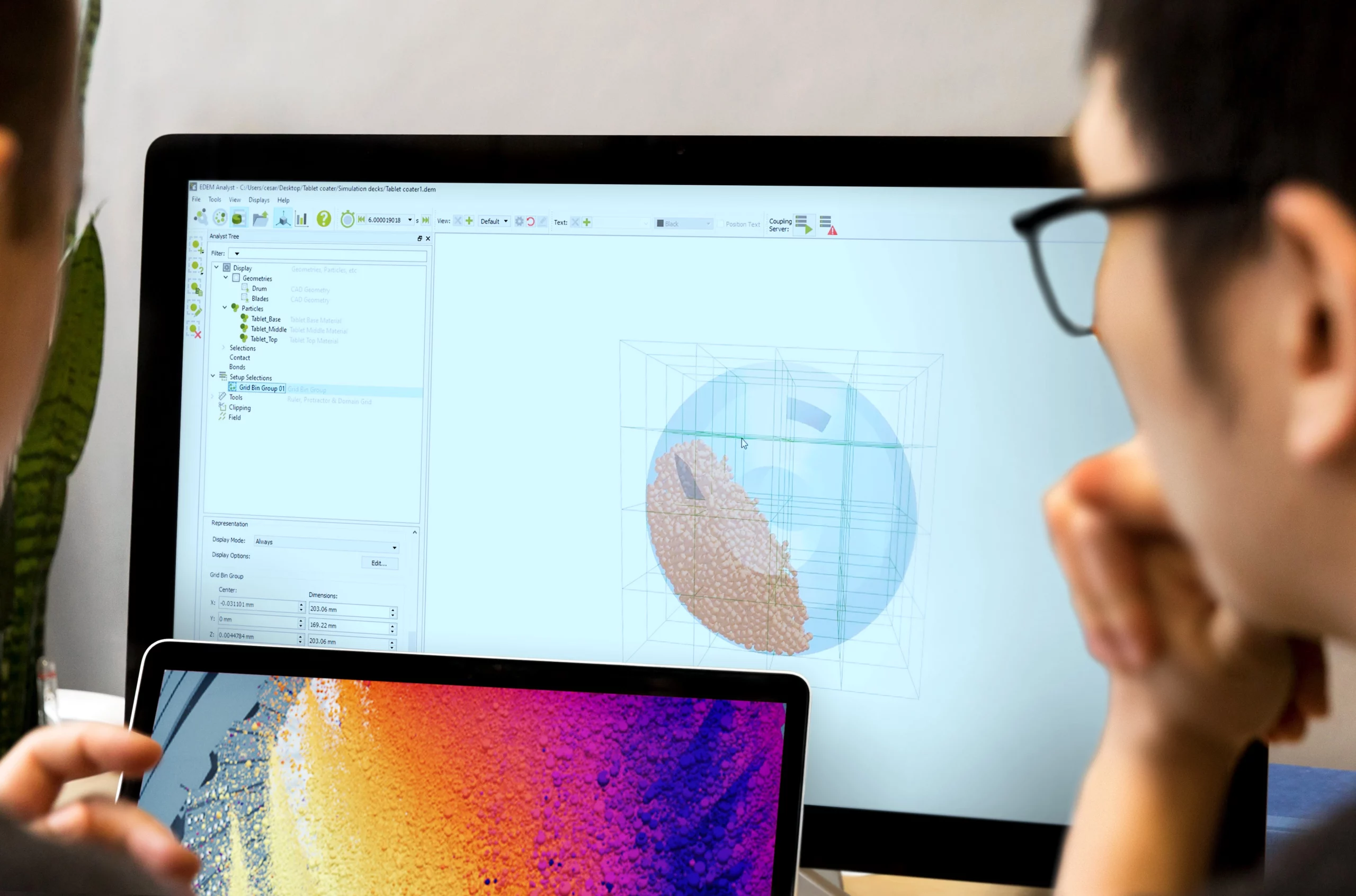
To address the challenge, MCE used Simcenter EDEM software to simulate the conveyor and mixing system virtually. As a Discrete Element Modelling software solution, Simcenter EDEM software enables engineers to model and analyse bulk material behaviour and understand how particles interact with equipment during operation.
In this project, the simulation was used to test diverter performance and mixer integration, helping the team optimise material flow and reduce segregation. It was also used to analyse material behaviour in ways that supported blockage prevention and improved process reliability. Different operating conditions could be assessed before physical implementation, allowing the team to explore system behaviour in a controlled virtual environment rather than relying only on physical trials.


Why This Approach Mattered
For bulk material handling systems, the ability to evaluate performance before making physical changes can significantly improve decision-making. Instead of reacting to problems only after they appear on the factory floor, engineers can study how the material behaves in the system and test adjustments in advance.
That is particularly valuable in food processing, where uptime, consistency, and quality all matter. In a system handling macadamia nuts, it is not enough for material to move from one point to another. The flow needs to remain stable, the process needs to avoid interruptions, and the product needs to remain as uniform as possible throughout conveying and mixing. Simcenter EDEM software helped support that level of understanding by giving MCE a clearer view of how the system behaved under different conditions.
The Results
The project delivered practical outcomes that improved both efficiency and process control. MCE was able to determine the optimal diverter operation needed to achieve the desired flow rate. The virtual testing process also helped prevent blockages and minimise segregation, while giving the team a clearer understanding of how incorporating a mixer affected material discharge.
By using simulation rather than relying only on factory-floor trial and error, MCE and Simcenter EDEM software supported a more efficient optimisation process that saved time and resources.
Why It Matters for Food Processing
Challenges in bulk material handling are common across many industries, but in food production they carry added importance because efficiency, product quality, and uptime are closely linked. Problems with flow, mixing, or segregation can affect output consistency and disrupt operations.
Simcenter EDEM software gives engineers a way to predict granular material behaviour, identify risks such as blockages or wear, test designs virtually across different materials, understand equipment-material interactions, and reduce reliance on physical prototypes. That makes it a valuable tool for teams that need better process insight before investing time and resources in physical modifications.
About Simcenter EDEM Software
Simcenter EDEM software is a Discrete Element Modelling solution used to simulate and analyse bulk material behaviour with high precision. It can be applied to materials such as grains, powders, ores, and fibres, helping engineers predict material flow, understand particle forces, and optimise equipment design before physical testing.
Its use extends across industries including mining, agriculture, pharmaceuticals, consumer goods, and food processing, where material behaviour plays a central role in equipment performance and process reliability.
The Bottom Line
Mpumalanga Consulting Engineers showed how simulation can improve conveyor and mixing system performance in macadamia nut production. By using Simcenter EDEM software to analyse material behaviour virtually, the team was able to improve flow control, reduce blockages, minimise segregation, and evaluate the effect of mixer integration before physical implementation.
For operations that depend on reliable bulk material handling, this kind of virtual testing supports faster optimisation, better process understanding, and more confident engineering decisions.
Next step: Book a discovery call or request a quote for Simcenter EDEM software from Simutron.
This content was adapted from an original Altair LinkedIn post.