Pharmaceutical manufacturing is full of variables, but few are as difficult to control as particulate behaviour.
In Oral Solid Dose production, powders and granules move through storage, transfer, blending, granulation, compression, and coating stages that all depend on predictable material flow. When that behaviour changes, even slightly, it can affect process reliability, product consistency, development timelines, and the confidence teams have when scaling from lab to production.
That is why deeper process visibility matters.
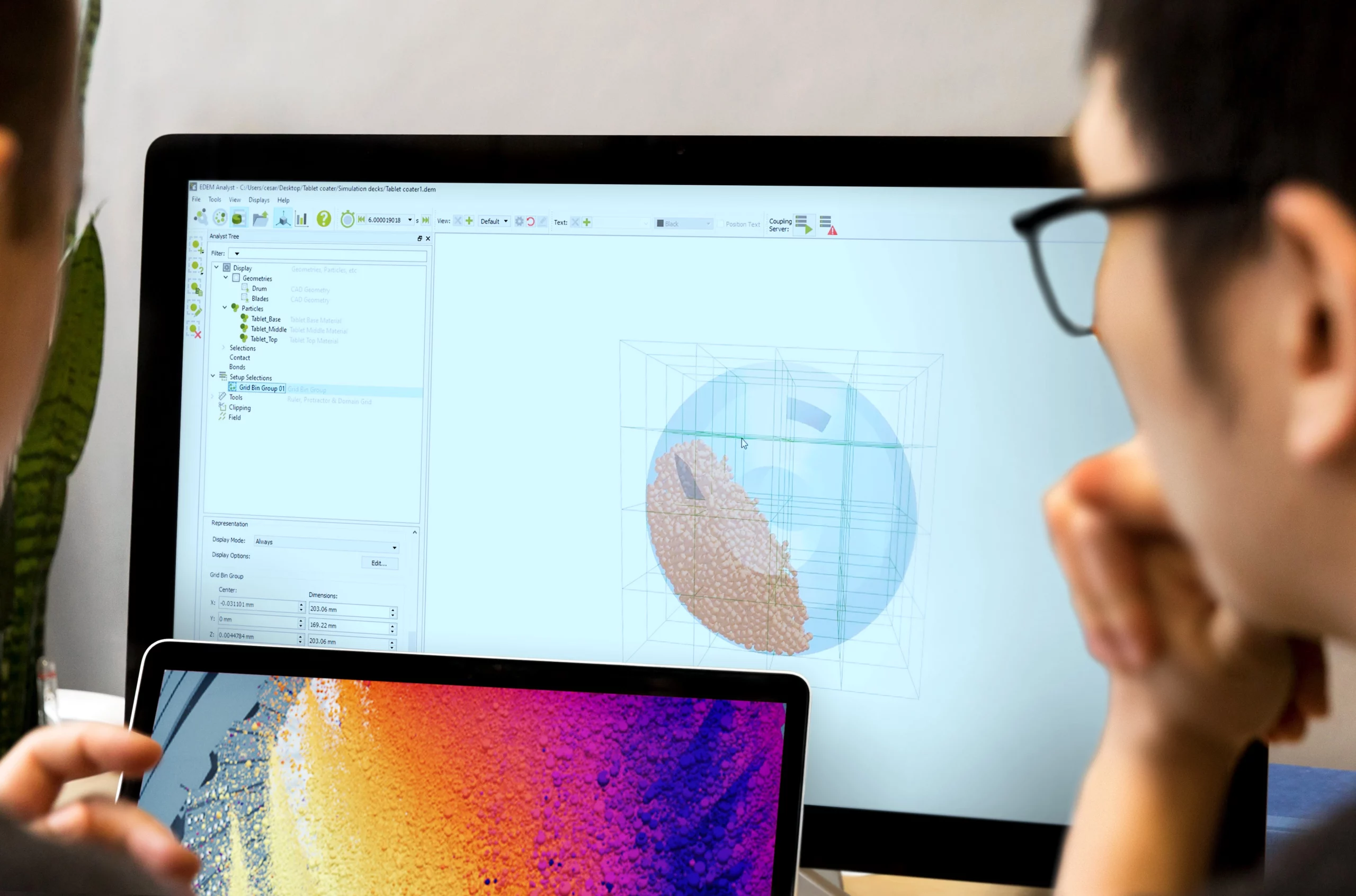
Simcenter EDEM™ software gives pharmaceutical manufacturers a way to analyse particulate material behaviour at particle scale using the Discrete Element Method (DEM). Instead of relying only on physical observation or repeated testing, teams can investigate what is happening inside the process with far more clarity. That makes it easier to understand how materials interact with equipment, how operating conditions influence behaviour, and where optimisation opportunities may exist.
For pharmaceutical engineering teams, that is not just a simulation advantage. It is a better way to make process decisions.
Why Particulate Behaviour Deserves More Attention
Powders rarely behave in a perfectly uniform way. Their performance depends on particle interactions, flow properties, equipment geometry, and process conditions. In pharmaceutical environments, those variables do not stay isolated. They influence one another throughout the manufacturing line.
A hopper that discharges inconsistently can affect downstream feeding. A blending system with dead zones can reduce uniformity. Granulation settings can alter particle stress and size distribution. Die filling behaviour can affect tablet consistency. Coating conditions can influence coverage and attrition.
These are not minor technical details. They sit at the heart of process stability and product quality.
Many of these behaviours are difficult to fully understand through physical testing alone. By the time an issue becomes visible in production, engineering teams may already be dealing with lost time, extra trials, or rework. Simcenter EDEM helps bring those hidden interactions into view much earlier, allowing teams to assess likely behaviour before a process change becomes expensive.
What Simcenter EDEM Brings to Pharmaceutical Teams
Simcenter EDEM is built to simulate particulate materials at particle scale, making it possible to study how powders and granules behave in pharmaceutical processing equipment. That particle-level view helps teams move beyond assumption and into analysis.
In practical terms, this supports three important engineering goals:
- gaining a deeper understanding of process mechanics
- informing process design and scale-up
- reducing dependence on physical prototyping
That combination is especially valuable in pharmaceutical manufacturing, where process decisions often carry quality, cost, and timing implications. Instead of treating simulation as a niche engineering exercise, teams can use it as part of a broader process development strategy.
The real value lies in seeing more, earlier. When engineers understand how particulate materials are likely to behave inside real equipment, they can evaluate process risks more effectively, make stronger design choices, and refine operating strategies with better technical grounding.
Building More Reliable Storage and Conveying Systems
Storage and conveying stages often receive less attention than core transformation processes, yet they can introduce major instability if powders do not move as expected.
Material can bridge, rat-hole, discharge unevenly, or develop unpredictable flow patterns that affect the rest of the manufacturing sequence. Once that happens, what appears to be a problem further downstream may actually begin much earlier in the material handling chain.
Simcenter EDEM helps teams predict flow patterns and blockages, while also supporting design and operational optimisation for improved reliability.
That matters because reliable handling is not just about moving powder from one point to another. It is about doing so consistently enough to support the entire process. With simulation, teams can assess likely issues in hoppers, feeders, bins, and transfer equipment before making physical changes. That creates a more proactive approach to reliability and a stronger engineering basis for equipment refinement.
Improving Mixing and Blending Confidence
Mixing and blending are fundamental to Oral Solid Dose manufacturing, but they are also highly sensitive to particle movement and process conditions.
Simcenter EDEM supports the analysis of convection and diffusion, dead zones, particle residence time, mixing and segregation rates, and virtual scale-up.
Those capabilities matter because blend quality is shaped by how material actually moves through the system, not simply by whether movement exists. A mixer may appear active, yet still contain areas of poor material exchange. Particles may segregate during motion. Residence time may vary across regions of the process. A system that performs well at one scale may behave differently at another.
Simulation helps engineering teams test those assumptions before scale-up or operational changes introduce unnecessary risk. It gives process specialists a more detailed way to study whether blending conditions are supporting the intended outcome and where adjustments may be needed.
Bringing Greater Control to Granulation
Granulation is another process area where small changes can have major downstream effects.
Simcenter EDEM can be used to analyse particle and granule stresses, predict granule size distribution, and determine the effect of operational parameters.
That is valuable because granulation influences much more than one isolated unit operation. Granule properties can affect handling, feeding, compression, and final product quality. If process conditions change particle stress or shift size distribution, those changes can ripple through the rest of the workflow.
With simulation, teams gain a clearer understanding of how granulation responds under different settings. That supports better process development decisions and helps reduce uncertainty when optimising operating parameters.
Understanding Tableting Beyond Compression Alone
Tableting performance starts long before final compaction. Material first needs to reach the die correctly, fill it consistently, and respond predictably under force.
Simcenter EDEM supports die filling analysis, including particle velocities and trajectories, mass flow rate, and size segregation. It also supports analysis of spatial distribution during compaction, including tablet compaction, particle forces and bulk stresses, and solid fraction distribution.
This is important because tableting issues are rarely caused by a single isolated variable. Filling behaviour, segregation patterns, internal force distribution, and solid fraction variation can all influence the final result. When engineering teams can study those variables in a virtual environment, they gain a more complete view of how tablet formation is actually developing inside the process.
That leads to better technical understanding and a more informed route to process optimisation.
Refining Tablet Coating Performance
Coating is one of the most visible stages in pharmaceutical production, yet it is still governed by complex particulate motion and equipment interaction.
Simcenter EDEM can be used to assess inter-tablet and intra-tablet coating uniformity, mixing efficiency, the effect of spray shape and rate, the effect of pan speed and baffle design, and tablet attrition.
These are critical areas of analysis. Coating quality depends on how tablets move relative to one another, how effectively they mix, how spray conditions interact with that motion, and how equipment design shapes internal behaviour. Attrition also needs to be considered where product integrity is important.
By allowing teams to investigate these factors in simulation, Simcenter EDEM supports a more structured and technically informed approach to coating development. Instead of adjusting variables through repeated trial-and-error alone, engineers can assess likely behaviour earlier and narrow the path to a better process window.
Supporting Machine Learning and Digital Twin Workflows
Pharmaceutical manufacturers are increasingly exploring more connected and data-driven process environments. Simcenter EDEM contributes to that shift in a practical way.
The software can be used to generate synthetic data as a cost-effective supplement to measurement data when developing machine learning-based digital twins of pharmaceutical manufacturing processes.
That creates additional value beyond traditional process simulation. Real-world plant data remains essential, but it is not always easy or economical to gather enough of it across every condition required for advanced modelling. Simulation-generated data can help strengthen those workflows by supporting broader analysis and development.
For teams working toward smarter pharmaceutical manufacturing, this creates a useful bridge between engineering simulation, operational data, and more advanced digital decision-making.
Reducing Setup Friction With Powder Material Models
One of the practical challenges in particulate simulation is access to suitable material models. Without them, even a capable simulation environment can take longer to translate into useful engineering work.
The EDEM Powder Material Model Database provides access to thousands of pre-calibrated powder material models.
That can significantly improve simulation readiness. For pharmaceutical teams, easier access to calibrated models helps shorten the setup phase and makes it more practical to investigate material behaviour across a wider range of scenarios. It also helps shift simulation from being a specialist-only activity toward becoming a more usable engineering resource in day-to-day development and optimisation work.
Why Simcenter EDEM Matters for Pharmaceutical Manufacturing
The strongest value of Simcenter EDEM is not that it simply models particles. It is that it helps pharmaceutical manufacturers understand process behaviour at a level that is otherwise difficult to access.
Across storage and conveying, mixing and blending, granulation, tableting, and coating, the software supports better visibility into how particulate materials behave under real process conditions. It also helps teams support process design, scale-up, reduced physical prototyping, and digital twin development.
For pharmaceutical engineering teams, that means fewer blind spots and more informed decision-making. It means being able to investigate process mechanics earlier, refine workflows more confidently, and reduce some of the uncertainty that often surrounds particulate manufacturing.
That is what makes Simcenter EDEM such a strong fit for modern pharmaceutical process environments.
The Bottom Line
Pharmaceutical manufacturing depends on understanding how powders and particles behave, not just at the start of development, but across the full process.
Simcenter EDEM gives teams a more detailed way to analyse that behaviour. By simulating particulate materials at particle scale, it helps pharmaceutical manufacturers investigate flow, mixing, segregation, granulation, die filling, compaction, and coating performance with far greater process visibility. It also supports scale-up decisions, reduces reliance on repeated physical prototyping, and contributes synthetic data to machine learning and digital twin workflows.
For companies looking to improve process understanding in Oral Solid Dose manufacturing, that makes Simcenter EDEM a highly practical and technically valuable solution.
If your organisation wants to explore how Simcenter EDEM can support pharmaceutical process development and optimisation, speak to Simutron about the right next step for your workflow.